CARMAX · 2024
Turning inventory uncertainty into a revenue opportunity
CarMax customers can put a car on hold, reserve a car for a test drive, or ship a car to their local store. When that happens, the status of the car changes to unavailable. However, roughly 73% of cars that are unavailable at any given time will not be purchased by the customer who initiated the hold, reservation, or shipment.
This means that inventory could be tied-up for a minimum of seven days, unable to be acted upon by other customers. This is a customer problem and a business problem.
The challenge
The used car market is distinctive in that every car is unique. Even if two cars are the same color, year/make/model, and trim level, the mileage and general condition will be singular to each specific VIN.
When customers discover a vehicle they love and see that it is unavailable, the experience feels very different from a typical out-of-stock product that is easily restocked in a few days. Carmax customers had no mechanism to get notified if a unique car they are interested in became available again.
The business problem
Unavailable inventory was tied up and couldn't be acted upon by customers. This created a significant business problem for CarMax.
Lost demand
No list of potential buyers
Lost visibility
No insight into these customers and their needs
Lost revenue
No mechanism for reengagement
The strategy
Approach
The business needed a way to preserve customer interest and maintain engagement without creating operational complexity.
My team coordinated efforts with the car merchandising team. We ran workshops, interviewed customers, and performed comparative/competitive analyses. We watched customer sessions, noting frustration and rage clicks, and identifying moments where we could help.
A year of customer research gave us confidence this could be game-changing for our customers and the business.
Insight
Research proved that these customers demonstrated strong purchase signals.
Honing
They narrowed down their vehicle choices.
Comparing
They compared YMM and trim levels.
Saving
They saved their favorites.
Monitoring
They returned again and again to keep tabs on cars.
Validation
We followed the rounds of discovery and research with a fake door test, which validated significant demand for a notification process informing customers who sign up about vehicle changes in status. This signaled we were ready to proceed with designs and development.
The designs
The resulting campaign, aptly named Notify Me, is an automated customer lifecycle campaign that enables shoppers to join a waiting list to receive availability updates on an unavailable vehicle. Customers can sign up for notifications about as many cars as they wish. Our core design principle was give customers useful information at exactly the moment that they need it.
Emails
Confirm sign-up
Status: Car is available again
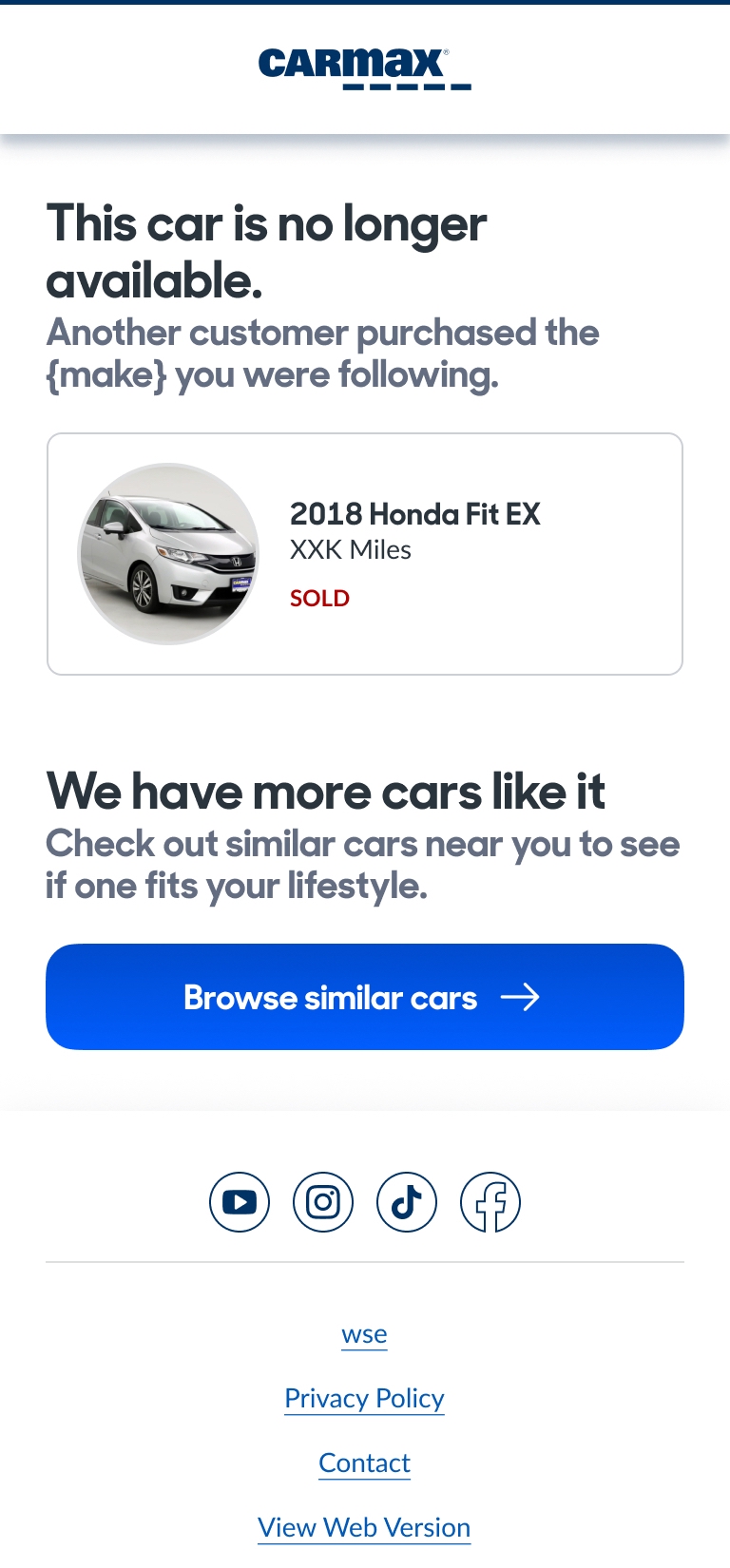
Status: Car is no longer available
Reaffirm: Receive updates
Cloud pages
I'm no longer interested
Customers who click the "I'm no longer interested" CTA on the Still interested email are taken to this cloud page to confirm their removal from status update notifications.
Continue to update me
Customers who click the "Continue to update me" CTA on the Still interested email are taken to this cloud page to confirm they wish to continue to receive status update notifications.
The release
The demand test proved customers were interested. It was time to release and evaluate via live testing for several weeks. We set the following points-of-view as goals for testing.
Business point of view
Customer point of view
Outcome & impact
$28M
Annualized sales
109%
Significantly high engagement
0.01%
Low unsubscribe rate
This campaign proved to be highly successful and established a scalable framework for future lifecycle and nurture campaigns.
Next case study
Content, product, and conversational designs